
Random Video Chat vs Text Chat: Which Is Better?
Compare random video and text chat: video offers real-time connection and trust; text gives privacy, flexibility, and less mental strain.
When deciding between random video chat and text chat, the optimal choice depends on your specific situation. Video chat provides real-time interaction with visual and auditory cues—ideal for building trust or emotional conversations. Text chat offers flexibility, lower cognitive demands, and privacy advantages.
Video Chat strengths: Real-time conversations, emotional depth, identity verification
Text Chat strengths: Convenience, privacy, asynchronous messaging
Quick Comparison
| Feature | Random Video Chat | Text Chat |
|---|---|---|
| Interaction Style | Real-time, face-to-face | Synchronous or asynchronous |
| Emotional Connection | Stronger due to visual cues | Weaker, text-only |
| Flexibility | Requires simultaneous presence | Respond at own pace |
| Privacy | Exposes face and environment | More private, no visuals |
| Mental Load | Higher, causes fatigue | Lower, less demanding |
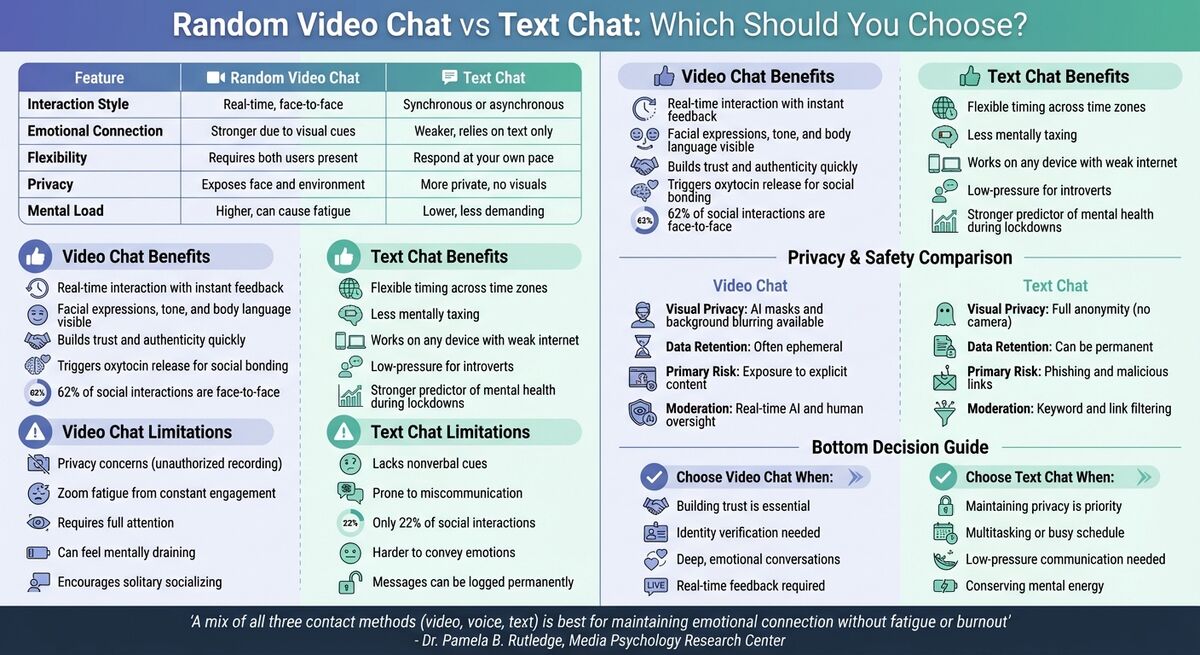
Video Chat vs Text Chat: Main Differences
Visual Cues vs Written Words
Video chat mirrors face-to-face interaction, leveraging facial expressions and body language to establish connection and activate oxytocin release. Text chat relies on written symbols like emojis and punctuation to convey tone.
People interpret indirect meanings more effectively when emojis accompany text compared to plain messaging alone.
According to Pamela B. Rutledge, Ph.D., Media Psychology Research Center Director: "The human brain is hardwired to respond to faces... Seeing the other person on video reinforces trust and personal connection and reduces the risk of misinterpretation compared to texting or voice calls."
However, video chat demands simultaneous processing of visual and auditory information, increasing cognitive load. Research indicates miscommunication occurs more frequently in text-based communication than in voice or in-person conversations.
Real-Time vs Flexible Timing
Video chat requires both participants to be present and engaged simultaneously, making it ideal for urgent decisions or emotionally sensitive conversations. Text chat offers asynchronous flexibility—send messages anytime, receive replies at the recipient's convenience. This eliminates pressure for instant responses but creates uncertainty about response timing and intent.
Random Video Chat: Benefits and Limitations
Benefits
- Creates "social presence" through nonverbal communication
- Enables instant, real-time feedback
- Builds trust and authenticity through visual verification
- Strengthens emotional bonds through oxytocin release
Limitations
- Privacy concerns: Risk of unauthorized recording or screen capture
- Zoom fatigue: Mental exhaustion from constant self-monitoring and eye contact
- Solitary socializing: Physical isolation despite perceived connection
- Lower mood outcomes: Research analyzing 1,000+ studies found fewer positive emotions during video versus in-person interactions
- Social disinhibition: Reduced behavioral constraints online
Brad Bushman, Ohio State University Communication Professor, notes: "If there is no other choice than computer-mediated communication, then it is certainly better than nothing. But if there is a possibility of meeting in person, then using technology instead is a poor substitute."
Text Chat: Benefits and Limitations
Benefits
- Flexibility: Schedule-independent communication across time zones
- Lower cognitive demand: No requirement to monitor facial expressions or tone
- Mental health support: A study of 411 participants found digital text communication predicted mental health outcomes better than physical activities during lockdowns
- Device compatibility: Works on nearly any device with minimal bandwidth
- Low-pressure communication: Ideal for introverts or anxious communicators
- Thoughtful responses: Time to craft measured, deliberate messages
Pamela B. Rutledge describes texting as "relational glue through ongoing, low-effort 'touches' between calls."
Limitations
- Nonverbal cue absence: Lacks facial expressions, tone, and body language—increasing misinterpretation risk
- Cognitive processing complexity: Text-based communication activates the dorsomedial prefrontal cortex, requiring complex mental processing
- Weaker emotional connection: Cannot satisfy social bonding needs equivalent to face-to-face interaction
- Limited interaction proportion: Face-to-face communication represents 62% of social interactions; text comprises only 22%
- Absence of vocal cues: Difficult to detect emotions and intentions behind written messages
Privacy and Safety Comparison
Video Chat Privacy
Video chat exposes personal environment, facial features, and real-time reactions. Major concerns include unauthorized recording. Platforms employ countermeasures:
- Glimmr: Anonymous connections without registration
- Chitchat.gg: AI-powered blurring of everything except chat partner's face
- ChatSpin: AI face masks
- Shagle: Background blur tools
Text Chat Privacy
Text chat provides visual anonymity—no camera exposure—eliminating recording risks. However, vulnerabilities include:
- Indefinite message logging creating permanent records
- Phishing link susceptibility
- Bot activity
- Catfishing schemes
Safety Features and Moderation
Video platforms use real-time AI and human content analysis for moderation. Text platforms rely on keyword filtering and malicious link monitoring. Biometric verification has reduced bot activity by up to 90% on verified platforms.
| Feature | Random Video Chat | Random Text Chat |
|---|---|---|
| Visual Privacy | AI masks and background blur available | Full anonymity (no camera) |
| Data Retention | Often ephemeral | Can be permanent |
| Primary Risk | Explicit content exposure | Phishing and malicious links |
| Moderation | Real-time AI and human oversight | Keyword and link filtering |
How to Choose Between Video and Text Chat
When Video Chat Works Best
Video chat excels when trust-building or identity verification is essential. Video calls foster trust through natural social cues and oxytocin release, making them optimal for meaningful conversations requiring emotional depth.
Research confirms: While both formats can ease negative emotions, only video or face-to-face interactions significantly elevate positive moods and fulfill human connection needs.
Best for: Building trust, emotional conversations, identity verification, deep relationships
When Text Chat Works Best
Text chat excels when flexibility and lower cognitive demand are priorities. It suits busy schedules, multitasking scenarios, and asynchronous communication across time zones.
Text communication minimizes cognitive load since it doesn't demand attention to visual and auditory cues simultaneously—explaining the prevalence of "Zoom fatigue."
Best for: Casual check-ins, busy schedules, privacy-conscious users, low-pressure interaction
Conclusion
No single format universally surpasses the other. Each possesses distinct advantages:
Video chat strengthens bonds and triggers oxytocin release, though being on camera induces draining mental fatigue.
Text chat enables relaxed connection through less cognitively demanding interaction, allowing thoughtful, measured responses without mood-boosting visual stimulation.
Strategic approach: Use video when trust-building is paramount; employ text for convenient, low-pressure communication.
Pamela B. Rutledge advises: "A mix of all three contact methods [video, voice, text] is best for maintaining emotional connection without fatigue or burnout."
Ultimately, personal requirements should guide your selection. Platforms like Glimmr facilitate format-switching, balancing trust, connection, and convenience seamlessly.
Frequently Asked Questions
What are the key privacy differences between video and text chat?
Video chat involves live audiovisual communication, exposing users to unauthorized recording and environment revelation risks. Text chat offers greater visual anonymity through written-only communication but faces phishing and permanent logging vulnerabilities.
How does video chat compare to text chat for mental health?
Video chat enables facial expression and body language visibility, creating stronger connection feelings and emotional support ideal for meaningful relationships. Text chat offers accessibility and convenience but lacks nonverbal cues necessary for deep emotional bonds.
When should you choose video chat to build trust?
Video chat suits situations requiring emotional connection and genuine interaction. Visible facial expressions, body language, and eye contact create credibility text cannot replicate. Research demonstrates face-to-face communication produces stronger social bonds and higher trust levels than text-based methods.