
The Ultimate Story Behind Omegle
Anonymity without accountability turned a viral chat novelty into a cautionary tale — the full history of Omegle, from bedroom project to shutdown.
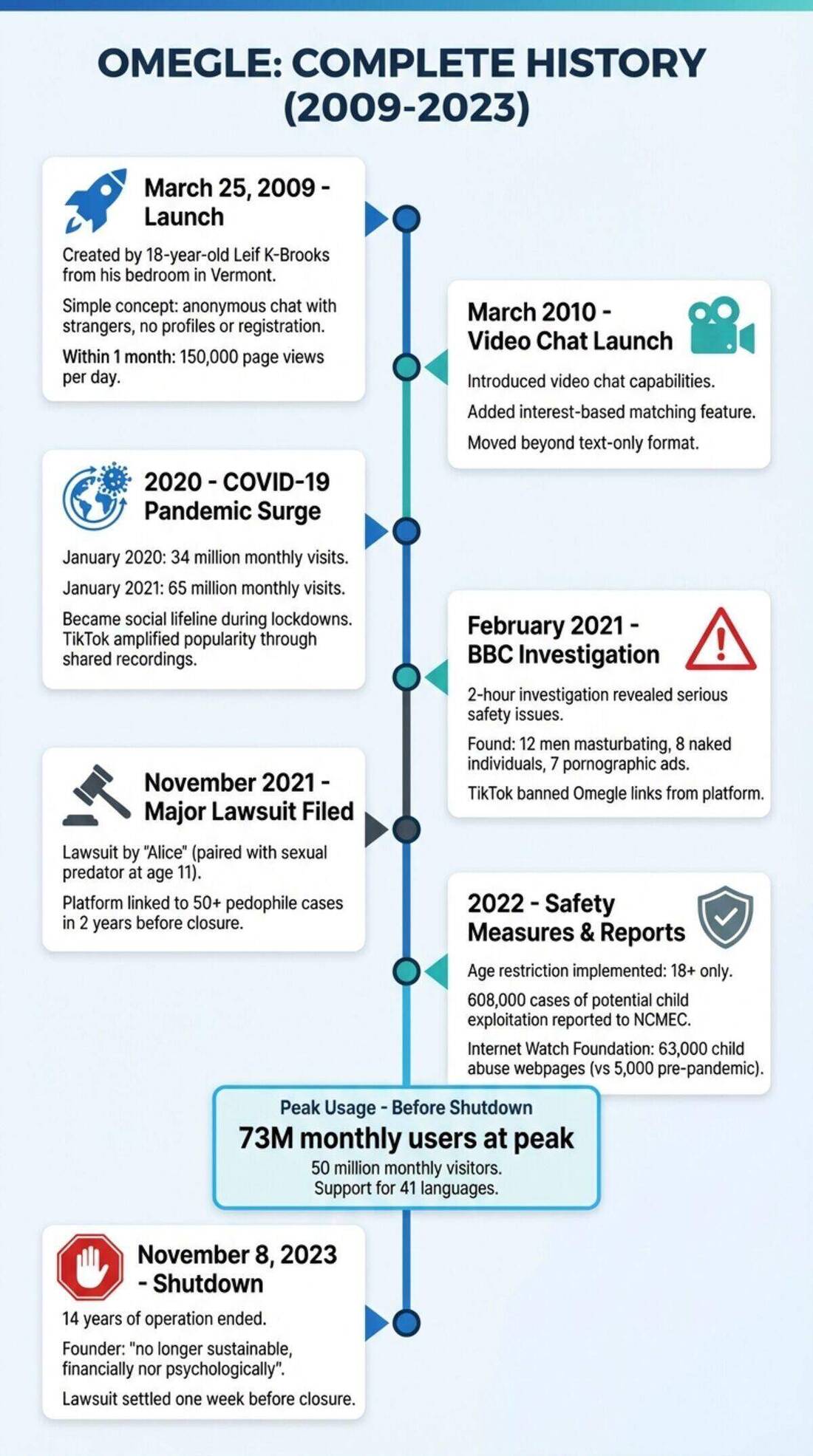
How Omegle Started
Leif K-Brooks: The Creator of Omegle
Leif K-Brooks was 18 when he launched Omegle from his bedroom in Brattleboro, Vermont, on March 25, 2009. Growing up in a small town and dealing with childhood trauma, he often felt isolated. The internet became his sanctuary. He later described the experience:
"The Internet gave me a refuge from that fear... I saw the miles of copper wires and fiber-optic cables between me and other people as a kind of shield."
The name "Omegle" came from a joked reference to an "error code omega." Within a month of launch, the site was attracting around 150,000 page views a day.
The Anonymous Chat Concept
K-Brooks described his vision for Omegle as something almost philosophical:
"If the Internet is a manifestation of the 'global village,' Omegle was meant to be a way of walking through the global village, engaging in spontaneous conversations with the people you ran into along the way."
He called it "The idea of 'meeting new people' distilled down to almost its platonic ideal." At launch, the platform was text-only — two strangers, no profiles, no registration, no history.
---
Major Developments in Omegle's History
Video Chat Launch and New Features
In March 2010 — just one year after launch — K-Brooks introduced video chat, transforming Omegle from a text curiosity into a face-to-face experience. Interest-based matching via keyword tags followed, letting users find others with shared interests. This feature, while well-intentioned, was later heavily misused during the pandemic years.
Growth During COVID-19
Omegle's biggest growth chapter was also its most troubled. During lockdowns, the platform became a social lifeline — especially for teenagers starved of in-person interaction. Monthly traffic jumped from 34 million unique visitors in January 2020 to 65 million by January 2021.
In March 2021, the New York Times covered the surge under the headline "Oh, So We're Doing Random Video Chat Again?" TikTok creators amplified the platform's visibility enormously, driving millions of new users. By 2022, Omegle attempted to restrict access to users 18 and older — but with no meaningful age verification, the restriction was largely symbolic.
---
Omegle's Closure in 2023
On November 8, 2023, after 14 years of operation, Omegle officially shut down. In a lengthy farewell post, founder Leif K-Brooks wrote:
"I can't risk a heart attack in my 30s."
He acknowledged that the financial and psychological cost of running the platform had become unsustainable. He also confronted the platform's darker legacy directly:
"There can be no honest accounting of Omegle without acknowledging that some people misused it, including to commit serious crimes."
In the two years before closure, Omegle was linked to more than 50 documented pedophile cases.
Moderation Problems and Legal Issues
A pivotal civil lawsuit was filed in November 2021. The plaintiff — referred to as "Alice," who was 11 years old at the time of the incident — alleged she had been matched with a convicted sexual predator on Omegle. The case was settled just one week before the platform's shutdown.
The legal and regulatory pressure mounted from multiple directions:
- TikTok banned all links to Omegle after a BBC investigation revealed children being paired with adults
- The UK Online Safety Act introduced new compliance requirements that platforms with poor moderation could not easily meet
- Professor Michael Salter, a leading expert on online child safety, stated: "its dangers were unsustainable, and its closure marked a necessary change"
K-Brooks closed his farewell with: "The battle for Omegle has been lost, but the war against the Internet rages on."
---
Omegle's Safety Record: The Numbers
The scale of Omegle's safety failures became undeniable in the years before shutdown:
- In 2022, Omegle reported 608,000 cases of potential child exploitation to NCMEC
- The Internet Watch Foundation logged 63,000+ webpages of child abuse material traced to Omegle in 2022, compared to roughly 5,000 pre-pandemic
- A two-hour BBC investigation in February 2021 documented 12 men masturbating on camera, 8 naked individuals, and 7 pornographic ads — all during a single session
The platform employed a single human moderator for millions of daily interactions. No age verification. No account requirement. No practical way to keep minors off the platform.
---
How Omegle Influenced Digital Culture
Popularizing Anonymous Online Interactions
Despite its problems, Omegle's cultural impact was real. Its random matching system supported 41 languages and normalized spontaneous global connections between strangers. It demonstrated that people genuinely wanted unscripted, unpredictable social interaction online — a thesis that continues to drive the category today.
Content creators on YouTube, TikTok, and Instagram built entire followings around Omegle videos. In 2020, a TikTok user captured a racist incident involving students from Shoreham-Wading River High School on Omegle, leading to school disciplinary action. After Omegle's closure, many creators migrated to Chatroulette, Monkey, and Ome.tv.
A Blueprint for What Not to Do
Omegle's failure is instructive. The platform proved that anonymity at scale, without any meaningful accountability, creates conditions for serious harm. Key lessons:
- Age verification matters — symbolic restrictions without enforcement are worthless
- One moderator for millions of users is not a moderation strategy
- Platform operators bear legal responsibility — the "we're just a service" defense has limits
- Reporting tools need to work — users who encounter abuse must have an accessible way to flag it
---
Anonymous Video Chat Platforms Today
Omegle's closure didn't end the category — it reset it. Platforms that have learned from its mistakes now operate with stronger safety frameworks:
| Platform | Key Safety Features |
|---|---|
| Glimmr | 18+, no account required, reporting system, active moderation |
| Ome.tv | Face detection to block trolls, AI + human moderation, ~14.7M monthly visits |
| Emerald Chat | "Karma" system (users rate each other), 24/7 human moderators + AI |
| Thundr.com | No account, no personal data collection, optional premium filters |
| OmeFree | WebRTC peer-to-peer connections, no data retention |
Glimmr in particular was built in direct response to the lessons of Omegle's rise and fall. It requires age verification, maintains a robust reporting system, and uses real-time moderation — while preserving the core appeal: genuine anonymity and no registration required.
---
What We Can Learn from Omegle
Omegle's arc from bedroom project to 73-million-user platform to forced shutdown is one of the defining cautionary tales of the social internet. It showed what happens when a genuinely novel idea scales without the infrastructure — technical, legal, and ethical — to support it safely.
K-Brooks himself acknowledged the human cost: "I thank A.M. for opening my eyes to the human cost of Omegle."
The platform's legacy isn't just a warning. It's evidence that anonymous connection is something people genuinely want — and that building it responsibly is hard but necessary. New laws like the UK's Online Safety Act now hold platforms legally accountable for foreseeable harms. The era of "we're just a website" is over.
For anyone using anonymous video chat today: don't share personal information, use platforms with visible moderation, and report bad behavior when you see it. The best platforms have built the infrastructure to act on those reports.
---
Frequently Asked Questions
Why did Omegle become so popular? Omegle was free, required no account, and offered text, voice, and video chat with strangers instantly. The spontaneity and unpredictability were the core draw. Pandemic-era isolation in 2020–2021 supercharged its growth to 65 million monthly users.
What made Omegle unsafe? Omegle had no age verification, employed a single human moderator for millions of daily sessions, and had no effective mechanism to remove bad actors. This allowed sexual predators to access the platform freely, exposing minors to explicit content and worse.
What safety features should an anonymous chat app have today? Effective anonymous chat platforms now combine: robust AI + human moderation, meaningful age verification, easy-to-use reporting and blocking tools, privacy controls, clear community guidelines, and legal accountability frameworks.
What replaced Omegle? Several platforms now operate in the space, including Glimmr, Ome.tv, Emerald Chat, and Thundr. The platforms that have survived and grown are those that built safety infrastructure Omegle lacked.