
How Anonymity-Preserving AI Moderation Works
How federated learning, differential privacy, encryption and behavioral analysis enable real-time, anonymous AI moderation without storing user data.
Anonymity-preserving AI moderation allows platforms to detect harmful content like hate speech or nudity while protecting user privacy. It avoids storing sensitive data by using techniques like real-time processing, federated learning, and encryption. This approach is essential for anonymous platforms like Glimmr, where users connect without accounts, ensuring safety without sacrificing privacy. Here's how it works:
- Real-Time Processing: Content is analyzed instantly without saving data.
- Federated Learning: AI moderates directly on user devices, avoiding cloud storage.
- Differential Privacy: Adds noise to data to prevent tracing back to individuals.
- Behavioral Monitoring: Tracks patterns (e.g., frequent reports) instead of user identities.
- Encryption: Ensures data security during analysis.
Platforms face challenges like handling coded language and moderating live video, but hybrid systems combining AI and human review help balance speed and accuracy. Glimmr stands out by avoiding accounts entirely, relying on automated AI moderation to maintain privacy and safety.
| Feature | Glimmr | Emerald Chat | Chitchat.gg |
|---|---|---|---|
| Account Requirement | None | Optional | None |
| Moderation | Real-time AI | Hybrid (AI + human review) | Real-time AI |
| Privacy Model | Behavioral tracking, no data saved | Temporary processing, no storage | Real-time blurring, no retention |
| Scalability | Fully automated | AI with human backup | Distributed processing |
Modern AI moderation systems ensure safety while respecting privacy, making them a key component for anonymous platforms to thrive in today's digital landscape.
Key Technologies for Anonymity-Preserving AI Moderation
Protecting user identities while detecting harmful content relies on three key technologies: differential privacy, k-anonymity with pseudonymization, and encryption.
Differential Privacy
Differential privacy (DP) ensures anonymity by introducing structured noise into datasets, making it nearly impossible to trace outputs back to individuals. This noise allows AI systems to identify patterns—like signs of harmful content—without letting any single user's data dominate the results.
There are two main approaches to DP:
- Local DP: Adds noise directly on the user's device, keeping raw data private.
- Global DP: Introduces noise after data collection.
For example, local DP is particularly useful in anonymous video chat services, where sensitive video data stays on the user's device.
The strength of DP is controlled by a parameter called epsilon (ε). A smaller ε means stronger privacy (more noise), while a larger ε offers better accuracy but increases re-identification risks. Techniques like Differential Privacy Stochastic Gradient Descent (DP-SGD) help train models on sensitive data—such as videos—while still identifying harmful content.
In December 2025, researchers Ziyuan Tao and Chuanzhi Xu introduced "FedVideoMAE", a federated video moderation framework using DP-SGD with adjustable privacy settings. This framework effectively detected violent content while slashing communication costs by 28.3 times.
"Differential privacy is a framework for measuring the privacy guarantees provided by an algorithm... the presence or absence of any individual in the dataset should not affect the output of the algorithm significantly." - ClanX AI
This balance between privacy and moderation accuracy is crucial for AI systems. Next, we'll look at how k-anonymity and pseudonymization add another layer of protection.
K-Anonymity and Pseudonymization
K-anonymity and pseudonymization further safeguard user data by masking or grouping identifying information.
- Pseudonymization: Replaces direct identifiers (like usernames or IP addresses) with artificial substitutes, often using hash matching. This technique enables secure comparisons against databases of illegal content without revealing the underlying data. For example, pre-upload screening and message franking use this method to allow users to report harmful content in encrypted environments.
- K-anonymity: Groups data so that any individual record is indistinguishable from at least k–1 others. In federated learning, for instance, devices send aggregated updates to a central server rather than raw data, ensuring individual contributions cannot be isolated.
| Feature | Pseudonymization | K-Anonymity / Aggregation |
|---|---|---|
| Core Mechanism | Replaces identifiers with surrogates (e.g., hashes) | Groups data to obscure individuals within a crowd of size k |
| Data Linkability | Tracks a "pseudonym" over time | Focuses on group averages to prevent individual tracking |
| Primary Use | Hash matching against blacklists | Federated learning with aggregated updates |
| Reversibility | Reversible if the mapping key is compromised | Irreversible when k is sufficiently large |
This layered approach is critical, especially as cases of child sexual abuse material (CSAM) have surged, affecting over 300 million children under 18 in 2024.
"Privacy and security protections are not incompatible. Cryptographic-based techniques offer promise in detecting illegal content while preserving user privacy on E2EE networks." - CETaS Research Report
Combining these methods with encryption ensures data remains secure throughout processing.
Encryption and Data Security
Encryption enables AI models to analyze data without accessing the raw content. This is vital for end-to-end encrypted (E2EE) platforms, which must balance privacy with legal obligations, such as those outlined in the UK Online Safety Act.
Fully Homomorphic Encryption (FHE) is a standout method, allowing computations on encrypted data. The results, when decrypted, match what would have been obtained from unencrypted data.
In 2024, NYU researchers introduced the Orion framework, which made FHE practical for deep learning. Orion achieved a 2.38× speedup on ResNet-20 and enabled FHE object detection on a YOLO-v1 model with 139 million parameters. This work earned the Best Paper Award at ASPLOS '24.
"FHE is a cryptographic technique that lets computers perform calculations on encrypted information while keeping it completely locked away. The magic happens when you decrypt the final result – it's identical to what you'd get if you had done the same calculation on the original, unencrypted data." - Maria Chatzou Dunford, CEO and Co-founder, Lifebit
Other methods, like Secure Multi-Party Computation (SMPC) and Private Set Intersection (PSI), enable collaborative analysis without exposing sensitive data. Standard encryption protocols, such as AES-256, ensure data security both at rest and in transit, maintaining compliance with regulations like GDPR, HIPAA, and PIPA.
AI Moderation System Types
Platforms use various moderation systems to manage harmful content while respecting user privacy. These systems are categorized into reactive, proactive, and hybrid models, each offering a different balance of speed, accuracy, and privacy.
Reactive Moderation
Reactive moderation kicks in only when users report content. This approach relies heavily on human judgment, which is better at interpreting context, subtle meanings, and intent than current algorithms. It's particularly effective for platforms like discussion forums or spaces with less risky user-generated content. However, the downside is clear: harmful content stays visible until flagged by a user. This delay in action is a major drawback. Surveys show that nearly 30% of users aged 18 to 34 believe stricter moderation policies should be enforced on social media platforms.
Proactive Moderation
Proactive moderation tackles harmful content before it reaches users. In this system, content—whether text, images, or videos—is analyzed in real time. If flagged as harmful, it's blocked or replaced with a placeholder like "[Message removed]". These systems use advanced technologies like multimodal detection, which combines tools like Image OCR and video recognition to screen both text and visuals. Large Language Models have replaced outdated keyword filters, allowing the detection of sarcasm, coded language, and even grooming behavior. However, proactive moderation isn't perfect—false positives remain a significant issue, especially on platforms where users lack an easy way to appeal flagged content.
Hybrid Moderation Models
For a more balanced approach, many platforms combine reactive and proactive methods into hybrid models. These systems leverage the speed and scalability of AI while incorporating human moderators for nuanced decision-making. AI handles clear-cut violations, such as spam or explicit content, while more complex cases—like sarcasm or culturally specific humor—are escalated to human reviewers.
For example, in October 2025, Emerald Chat adopted a hybrid system. Their AI performed real-time checks, flagging ambiguous content for human review to ensure 24/7 moderation and thoughtful handling of sensitive issues.
"If moderation were 100% AI, false bans could happen. If it were fully manual, the system couldn't handle large volumes of content"
This model also benefits human moderators by filtering out the most disturbing material, which helps protect their mental health. AI-driven severity scores can improve efficiency by 25%, prioritizing high-risk situations like threats or doxxing. However, hybrid systems are resource-heavy, requiring significant human involvement, sophisticated tools, and clear escalation protocols. Despite the costs, platforms managing massive user bases find this investment worthwhile for improving both safety and operational efficiency.
| Moderation Type | Timing | Key Advantage | Main Drawback |
|---|---|---|---|
| Reactive | After content is live | Human context and empathy | Delayed response; harm visible |
| Proactive | Before or during post | Prevents harm pre-exposure | Risk of false positives |
| Hybrid | AI scans first; humans review | Combines speed and accuracy | Resource-intensive |
How Glimmr Uses Anonymity-Preserving Moderation

Glimmr's Moderation System in Practice
Glimmr's moderation system focuses on analyzing content instantly without tracking user identities. Within less than a second, the platform scans videos and text to detect violations like nudity, hate symbols, or abusive language. If harmful content is identified, the system immediately blurs video streams or blocks messages before they can reach the recipient. This ensures a seamless balance between user privacy and maintaining a safe environment.
Rather than collecting personal data, Glimmr monitors behavioral patterns to identify problematic users. The system looks for indicators such as frequent chat switches, high report rates from other users, or interaction styles resembling bot activity. These patterns allow the platform to enforce community guidelines by restricting access based on behavior alone. Users can also report violations, and the platform analyzes metadata to address abuse while keeping both parties anonymous.
"Anonymity is essential for free speech and expressing dissent, but platform moderators need ways to police bad actors." - Maurice Shih et al., University of Maryland
This approach means users can enjoy Glimmr's instant video chat services without needing to create an account. Safety is upheld through AI-driven behavioral monitoring, ensuring privacy remains intact.
Glimmr vs. Competing Platforms
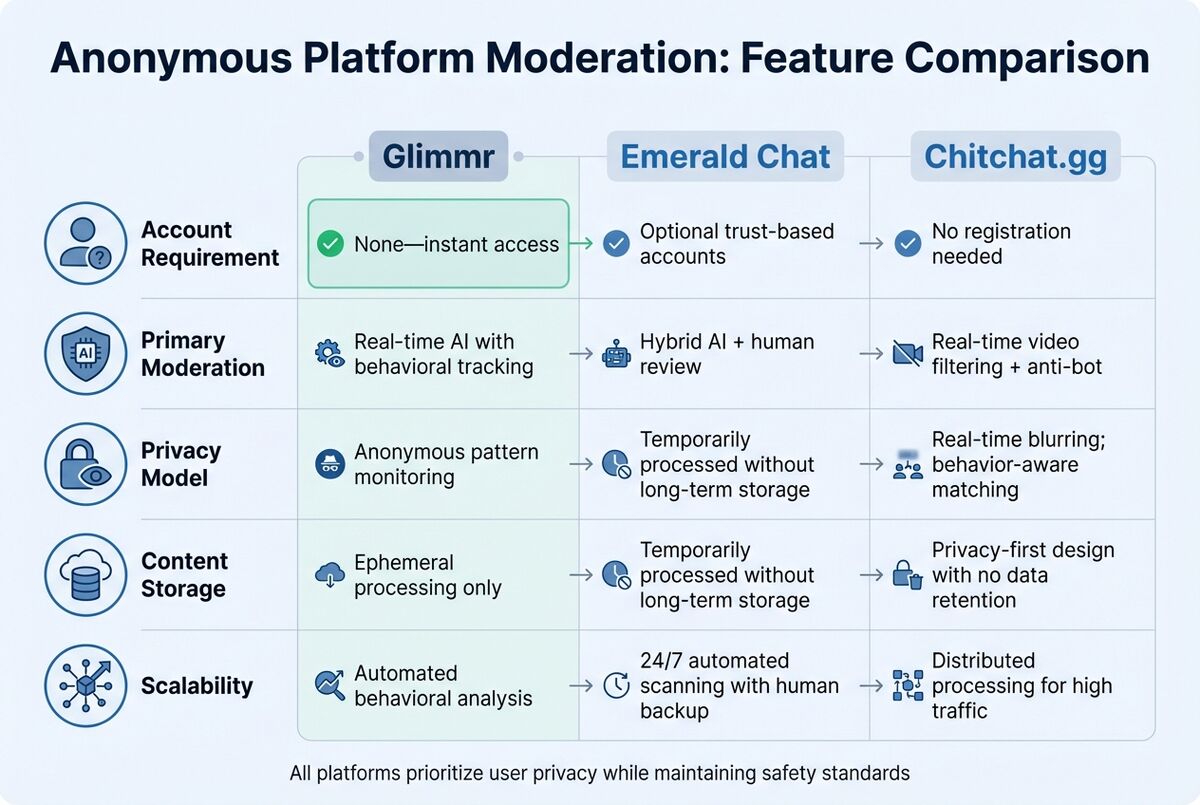
Glimmr takes a unique stance by eliminating the need for user accounts entirely, setting it apart from competitors. While other platforms balance privacy and safety differently, Glimmr's no-account model stands out. For instance, Emerald Chat employs a hybrid system with human moderators reviewing flagged content, while Glimmr leans heavily on automated AI to deliver instant access.
| Feature | Glimmr | Emerald Chat | Chitchat.gg |
|---|---|---|---|
| Account Requirement | None - instant access | Optional trust-based accounts | No registration needed |
| Primary Moderation | Real-time AI with behavioral tracking | Hybrid AI + human review | Real-time video filtering + anti-bot |
| Privacy Model | Anonymous pattern monitoring | Temporarily processed without long-term storage | Real-time blurring; behavior-aware matching |
| Content Storage | Ephemeral processing only | Temporarily processed without long-term storage | Privacy-first design with no data retention |
| Scalability | Automated behavioral analysis | 24/7 automated scanning with human backup | Distributed processing for high traffic |
The choice becomes clear: platforms with human moderators often handle nuanced contexts like sarcasm or cultural subtleties better, but they can be slower and require more resources. Glimmr, on the other hand, prioritizes speed and anonymity, using AI to make rapid decisions that safeguard users while avoiding the need for identity verification. This makes it an appealing option for those who prefer instant, hassle-free connections over platforms that demand account creation or identity management.
Ethical and Practical Considerations
Privacy vs. Safety Trade-offs
Platforms face a tough challenge: blocking harmful content without compromising user privacy. This becomes even trickier with end-to-end encryption, which restricts access to raw data.
Privacy-enhancing technologies (PETs) offer a promising path forward. Tools like Zero-Knowledge Proofs and Private Set Intersection allow platforms to verify harmful content without decrypting user data, ensuring privacy remains intact. Glimmr provides another example by using behavioral analytics—such as monitoring chat-switching frequency and user report rates—to detect abuse while maintaining user anonymity.
The stakes are high. In 2024, over 300 million children under 18 were exposed to illegal online content, and severe cases of child sexual abuse material have more than doubled since 2020. On top of that, approximately 6.6 million UK consumers fell victim to online fraud in the same year. These statistics highlight the delicate balance between safeguarding privacy and ensuring safety.
By leveraging these technical solutions, platforms can address these challenges while aligning with regulatory requirements.
Legal and Regulatory Compliance
As privacy and safety measures evolve, regulations are keeping pace, requiring platforms to navigate a complex legal landscape. Platforms in the United States must adhere to privacy laws and the Wiretap Act, especially when dealing with encrypted communications. Meanwhile, European regulations like the EU AI Act, GDPR, and the Digital Services Act impose strict rules around transparency and accountability.
In the UK, the Online Safety Act demands the removal of "priority offenses", such as child sexual abuse material, terrorist content, and fraud, all while limiting privacy intrusions. Additionally, regulators like Ofcom may recommend specific technologies for detecting illegal content, pressuring platforms to adopt standardized tools.
Glimmr's approach simplifies some of these hurdles. By avoiding long-term storage of personal data, the platform aligns with GDPR's data minimization principle, collecting only what's absolutely necessary. Its behavioral monitoring system identifies harmful patterns without creating detailed user profiles, striking a balance between regulatory compliance and user anonymity.
Larger platforms face even more stringent requirements. Those classified as "Category 1" under the UK Online Safety Act must conduct risk assessments—and in some cases, publish them—to prove their safety measures are effective. Failure to comply with GDPR can result in fines of up to €20 million or 4% of annual global revenue, making adherence to these laws a critical business priority.
Conclusion
Anonymity-preserving AI moderation brings together privacy and safety through tools like differential privacy, encryption, behavioral analysis, and multimodal AI. These systems work to shield users without relying on invasive surveillance or storing personal data. This approach lays the groundwork for platforms like Glimmr to enforce moderation effectively while respecting user privacy.
As highlighted in the key technologies section, methods such as differential privacy and on-device processing allow Glimmr to deliver real-time, anonymous moderation. The platform's no-account, ephemeral-data model ensures compliance with privacy regulations while fostering a secure environment. For instance, when inappropriate content is detected, the AI takes immediate action by blurring or blocking it. If abusive patterns arise—like frequent session skipping or repeated user reports—the system responds automatically, all without creating identifiable user profiles.
"AI isn't here to replace the human experience - it's here to protect it." - Chitchat.gg
Modern AI moderation systems boast impressive metrics, achieving up to 99.9% accuracy and reducing manual workload by 92.8%. This is especially critical given that unmoderated platforms see 10–15% of sessions involving inappropriate content. Relying on these advancements ensures that platforms can continue to provide secure and accessible communication spaces.
The future of these platforms will depend on maintaining this balance. As regulations tighten and user expectations grow, success will favor platforms that adopt smart, context-aware moderation while preserving anonymity. Technologies like federated learning, on-device processing, and context-rich AI will play a key role in crafting environments where users can feel both safe and free.
FAQs
Can AI moderate video chat without storing my video or messages?
AI moderation is capable of analyzing video streams in real time without storing your videos or messages. This is made possible through privacy-focused techniques like selective anonymization, which hides identifiable information, and federated learning, where data is processed locally on your device. These methods ensure that user identities remain protected and anonymous throughout the moderation process.
How does Glimmr spot repeat abusers without accounts or identities?
Glimmr employs cutting-edge privacy-focused moderation tools to identify repeat offenders without needing personal accounts or identities. By leveraging cryptographic techniques such as anonymous credentials and metadata-private moderation, the platform can monitor abusive behavior and enforce actions like bans without exposing user identities. Paired with AI-powered content filtering and behavioral analysis, this approach ensures efficient moderation while safeguarding user anonymity.
What makes privacy-preserving moderation less accurate than regular AI?
Privacy-preserving moderation often sacrifices some accuracy to protect user privacy. Methods such as encryption and federated learning are designed to safeguard personal information, but they also limit the system's capacity to thoroughly analyze content. As a result, these systems might overlook harmful material that traditional AI, with full access to user data, could identify more reliably. This trade-off highlights the challenge of balancing privacy with effective content moderation.