
How Moderation Works on Video Chat Platforms
How real-time AI, human review, and user controls combine to moderate anonymous video chat while protecting privacy and meeting compliance.
Moderating anonymous video chat platforms is challenging because interactions happen live, leaving no room for post-review. Platforms must balance user safety, legal obligations, and privacy. Here's how they manage it:
- AI Moderation: AI analyzes video, audio, and text in real-time using techniques like frame sampling, speech analysis, and behavior tracking. It flags harmful content (nudity, violence, hate symbols) with confidence scores to trigger automated actions or human review.
- Human Oversight: Safety teams handle ambiguous cases, ensuring context is considered. They review flagged content, process user reports, and manage appeals.
- User Tools: Features like skip, mute, block, and reporting empower users to control their experience. Interest-based matching and privacy controls further enhance safety.
- Layered Enforcement: Platforms use tiered penalties - from warnings to permanent bans - for violations, escalating based on severity.
- Transparency & Compliance: Strict age verification, clear guidelines, and fast reporting systems ensure platforms meet global safety standards.
Platforms like Glimmr combine AI and human moderation to create safer environments, addressing live risks without compromising user privacy.
AI-Powered Moderation Techniques
AI moderation on video chat platforms operates by analyzing live streams in real-time without recording entire conversations. Instead of reviewing every second, the system uses a method called frame sampling, where it extracts keyframes every 2 to 3 seconds from active video feeds. This approach keeps the process efficient and fast while still identifying potential violations. Once these keyframes are captured, they undergo detailed analysis.
The AI evaluates the extracted frames to detect violations. Through computer vision, it scans for harmful content such as explicit sexual acts, non-explicit nudity, violence (including blood, gore, and weapons), drugs, alcohol, hate symbols, and offensive gestures. Beyond visuals, the system also monitors user behavior, like frequent chat skipping or attempts to bypass filters, and analyzes speech patterns to detect bots or scripted harassment. For example, rapid skipping between chats may signal trolling activity.
Each flagged detection is assigned a confidence score, indicating how certain the AI is about the violation. A frame flagged for explicit nudity with a 98% confidence score typically triggers an immediate automated response, such as blurring the video, muting the user, or issuing a temporary ban. On the other hand, content flagged with a lower confidence score - like a boxing match mistakenly identified as violent - falls into a gray area and is escalated to human moderators for further review. Platforms adjust these thresholds based on their tolerance for false positives. Higher thresholds (95% or above) reduce errors but may miss some violations, while lower thresholds catch more issues but increase the workload for human moderators.
This system is crucial for managing the immense scale of video chat platforms, where a single user generates about 102 MB of data every minute. Platforms like Glimmr lean on these AI techniques to detect and address harmful content quickly. The system also processes frames asynchronously, ensuring there's no lag and maintaining smooth video quality.
Automated Detection and User-Control Tools
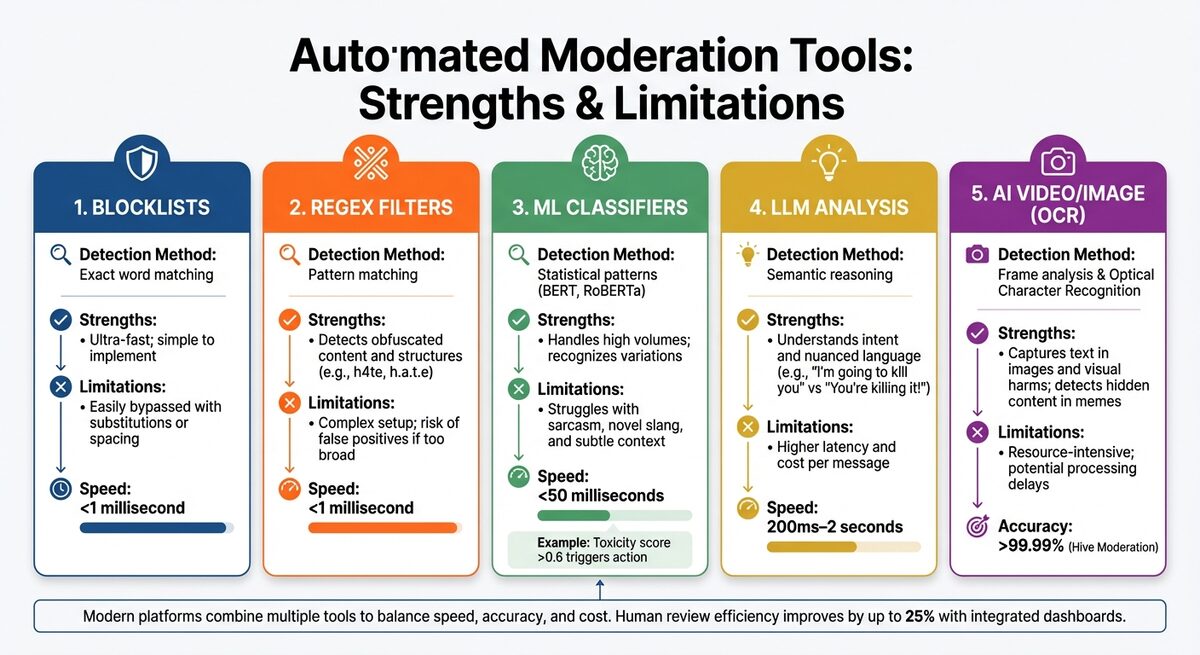
AI's ability to analyze frames in real-time has led to advanced tools that protect users from harmful content. Beyond frame sampling, platforms rely on automated systems to prevent violations before they happen. Rules-based filters are a key component, leveraging blocklists and Regular Expressions (Regex) to instantly block harmful keywords or patterns like "fr33 m0n3y". These filters are lightning-fast, operating in under one millisecond, making them perfect for filtering out obvious spam or profanity. However, they can be easily bypassed with typos or clever substitutions.
Machine learning classifiers take a more nuanced approach by analyzing patterns rather than seeking exact matches. Models such as BERT or RoBERTa assign probability scores to content, flagging messages with toxicity levels above 0.6 for automatic blocking or human review. These systems are efficient, handling high volumes with a latency of under 50 milliseconds, but they can struggle with sarcasm, evolving slang, and subtle contextual cues. Large Language Models (LLMs), on the other hand, excel at understanding intent. For instance, they can differentiate between "I'm going to kill you" (a threat) and "You're killing it!" (a compliment). However, this deeper analysis comes with higher latency (200 milliseconds to 2 seconds) and increased costs per message.
Platforms also use Optical Character Recognition (OCR) to detect harmful text hidden in images or memes - content that traditional text filters might miss. This is particularly useful for catching screenshots of offensive messages or phone numbers used to evade moderation. Additionally, behavioral recognition identifies users who repeatedly try to bypass filters, enabling platforms to take proactive action, such as banning these users before they escalate violations. Together, these layers create a robust system for moderating content.
Content Filters and Blocklists
Blocklists are the first line of defense, designed to instantly block profanity, slurs, and spam phrases through exact word matching. Their simplicity allows them to operate at sub-millisecond speeds, but they're easy to bypass - users can add spaces or swap letters to evade detection. Regex filters address this limitation by catching obfuscated content and specific patterns, such as URLs or phone numbers. For example, Regex can identify variations like "h4te" or "h.a.t.e" even when users try to disguise the word.
Sentiment analysis adds another layer by assessing the emotional tone of messages. Instead of focusing on individual words, these systems evaluate whether a conversation is becoming hostile or aggressive. This allows platforms to intervene with automated warnings or cool-down timers before things spiral out of control. By combining blocklists, Regex, and sentiment analysis, platforms create a more comprehensive defense system that's harder for bad actors to bypass.
User Controls for Safety and Customization
Automated tools are complemented by user controls that give individuals the power to shape their own chat experience. Skip, mute, and block functions allow users to end uncomfortable conversations or silence disruptive participants instantly. Platforms like Glimmr make these features accessible with a single tap, offering users immediate control. Interest-based matching - using tags like gaming, music, or language exchange - helps connect users with similar interests, reducing the likelihood of encountering bots or disruptive individuals.
Privacy controls give users additional options, such as turning off cameras or switching to text-only mode, helping them manage their level of exposure. Some platforms also offer adaptive safety settings, which adjust moderation filters based on a user's past experiences. For instance, if someone frequently encounters uncomfortable conversations, the system can automatically increase moderation sensitivity for their future interactions. Users can also report problematic messages or profiles, triggering a review by AI or human moderators. Some platforms aim to review such reports within minutes, using this feedback to continuously improve their AI models.
Comparison of Automated Tools
Each moderation tool serves a specific purpose, and platforms often combine them to balance speed, accuracy, and cost. Here's a breakdown:
| Tool Type | Detection Method | Strengths | Limitations |
|---|---|---|---|
| Blocklists | Exact word matching | Ultra-fast; simple to implement | Easily bypassed with substitutions or spacing |
| Regex Filters | Pattern matching | Detects obfuscated content and structures | Complex setup; risk of false positives if too broad |
| ML Classifiers | Statistical patterns | Handles high volumes; recognizes variations | Struggles with sarcasm, novel slang, and subtle context |
| LLM Analysis | Semantic reasoning | Understands intent and nuanced language | Higher latency (200ms-2s) and cost per message |
| AI Video/Image | Frame analysis & OCR | Captures text in images and visual harms | Resource-intensive; potential processing delays |
Industry-leading visual moderation services such as Hive Moderation are reported to reach over 99.99% accuracy, and modern moderation dashboards that integrate these tools can improve human review efficiency by up to 25%. The key is choosing the right tool for the right situation - stricter filters for fast-paced public livestreams and more lenient ones for private, one-on-one chats.
The Role of Human Moderation and Hybrid Models
AI can analyze millions of frames per second, but it often struggles with nuances like sarcasm, subtle intent, or context. That's where human moderators - often called safety specialists or trust & safety teams - step in to handle ambiguous cases. This creates a hybrid model that merges the speed of AI with the nuanced understanding of human judgment. As one moderation provider puts it, a hybrid system "combines the speed of AI with human judgment in one workflow."
This model helps reduce false positives by routing uncertain cases to human reviewers instead of automatically banning users for borderline content. For instance, an AI might flag the phrase "I'm going to kill it at this game!" as threatening, but a human moderator can quickly identify it as harmless gamer slang. Layering human oversight on top of automated visual AI catches what either system would miss on its own, improving fairness and contextual understanding.
This hybrid model naturally supports a progressive approach to enforcing platform rules.
3-Step Enforcement Process
Most platforms use a tiered enforcement system that escalates actions based on the severity of violations. Minor offenses, like mild profanity or spamming, usually result in an educational warning, encouraging users to adjust their behavior without immediate penalties. If the behavior persists, the platform may impose temporary timeouts or mutes. For more serious violations, such as sharing graphic violence or Child Sexual Abuse Material (CSAM), platforms respond with immediate permanent bans and, in some cases, report the behavior to law enforcement.
This structured approach helps differentiate between occasional errors and deliberate rule-breaking. Users also have tools like skip, block, and mute, which allow them to manage uncomfortable interactions instantly without waiting for moderator involvement. Together, automated alerts, human review, and user controls create a multi-layered safety system.
Hybrid Moderation for Contextual Accuracy
In hybrid moderation, content flagged by AI is assigned confidence scores. High-confidence cases, like explicit nudity or hate speech, are automatically blocked, while lower-confidence cases are reviewed by human moderators to ensure context is considered. Intelligent dashboards make this process more efficient, allowing moderators to work up to 25% faster by providing full conversation context and enabling batch actions.
Human moderators are also essential in the appeals process, ensuring fairness when users contest bans - whether automated or manual. To improve accuracy, platforms often hire native speakers who understand regional dialects and cultural nuances, helping identify slurs or subtle context that AI might miss. Additionally, tools like content blurring protect moderators by masking graphic material, reducing the risk of burnout and trauma.
For repeat offenders, stricter measures come into play.
Permanent Actions for Repeat Offenders
Platforms monitor repeat offenders using behavioral pattern recognition and device-level signals such as browser fingerprints and IP addresses. Severe cases, such as CSAM, result in immediate permanent actions like IP blocking and reporting to law enforcement.
The goal of hybrid moderation isn't to replace human judgment but to create a system that scales effectively. By combining AI's ability to process vast amounts of data with human expertise in understanding context, platforms can provide a robust safety net for their communities.
Reporting, Transparency, and Compliance

User Reporting and Escalation
Reporting is most effective when it's a tap away. The strongest platforms let users flag a profile or conversation directly from the chat, and let them attach context - a screenshot or the message in question - so moderators get a complete picture instead of having to guess. Clear, actionable reports help review teams resolve issues faster.
Once a report is submitted, a moderation team reviews it, with AI alerts pushing the most serious violations to the front of the queue. Minor infractions often lead to educational guidance that explains the rule that was broken, while severe violations can result in temporary or permanent bans. Keeping logs of flagged accounts helps platforms recognize repeat offenders and keep the community safer over time.
Transparency and Accountability in Moderation
Transparency matters as much as enforcement. Clear, upfront community guidelines set expectations before a conversation even starts. For minor or first-time violations, the better platforms prioritize education over punishment, and they rely on a "human-in-the-loop" review process - where a person validates flagged reports rather than depending solely on automation - to keep borderline calls fair.
Age assurance is the other pillar. Reputable platforms enforce an 18+ standard, and regulators are steadily raising the bar on what counts as "enough." The UK Online Safety Act (effective July 25, 2025), for example, pushes platforms toward robust age-checking that goes beyond simple self-declaration. Expect age assurance and proactive safety design to become baseline requirements rather than differentiators.
Conclusion: Building Safer Video Chat
Anonymous video chat platforms come with unique safety hurdles, but pairing advanced technology with human oversight can create a secure environment. The strongest approach is layered: AI watches video, audio, and text in real time and acts on high-confidence violations instantly, while human reviewers handle the ambiguous cases that genuinely need judgment. Add strict age assurance and harmful content can be caught in milliseconds without putting the weight of safety entirely on users.
What makes the best platforms stand out is their focus on privacy-conscious AI. Instead of constant human monitoring, automated systems surface behavioral patterns - like frequent skipping or attempts to bypass safety features - so moderators can intervene before issues escalate, without watching every conversation.
User participation also plays a crucial role in reinforcing safety. Features like reporting tools, profile flagging, and customizable safety filters empower users to contribute to a platform's moderation efforts. When users report inappropriate behavior and provide screenshots, moderators can act quickly to maintain a secure community.
The future of video chat safety lies in a balanced approach that merges AI efficiency with human insight. Platforms that prioritize hybrid moderation, clear policies, and user involvement create spaces where people can connect safely and confidently, free from harmful interactions.
FAQs
Do video chat platforms record your video or audio to moderate it?
Not necessarily. Many platforms moderate by sampling occasional keyframes and analyzing speech in real time rather than storing entire conversations, and privacy-focused services lean on automated tools like speech recognition and natural language processing instead of constant recording. Practices vary widely, though, so the only reliable way to know what a given platform keeps is to read its privacy policy.
What happens if a moderation AI flags you by mistake?
False positives happen - a boxing clip read as violence, gamer slang read as a threat. That's exactly why hybrid systems route lower-confidence cases to human reviewers, and why reputable platforms offer an appeals path through support or a moderation review so errors can be corrected.
How can I stay safer during anonymous video chats?
Stick to platforms that offer strong moderation tools - AI-driven content filtering, real-time behavior monitoring, and easy reporting. Be cautious about sharing any personal or sensitive information, steer clear of explicit details, and watch for red flags like suspicious links or odd requests. Don't hesitate to skip, block, or report harmful behavior immediately. Platforms that emphasize safety features help protect you from scams, harassment, and exposure to inappropriate content.