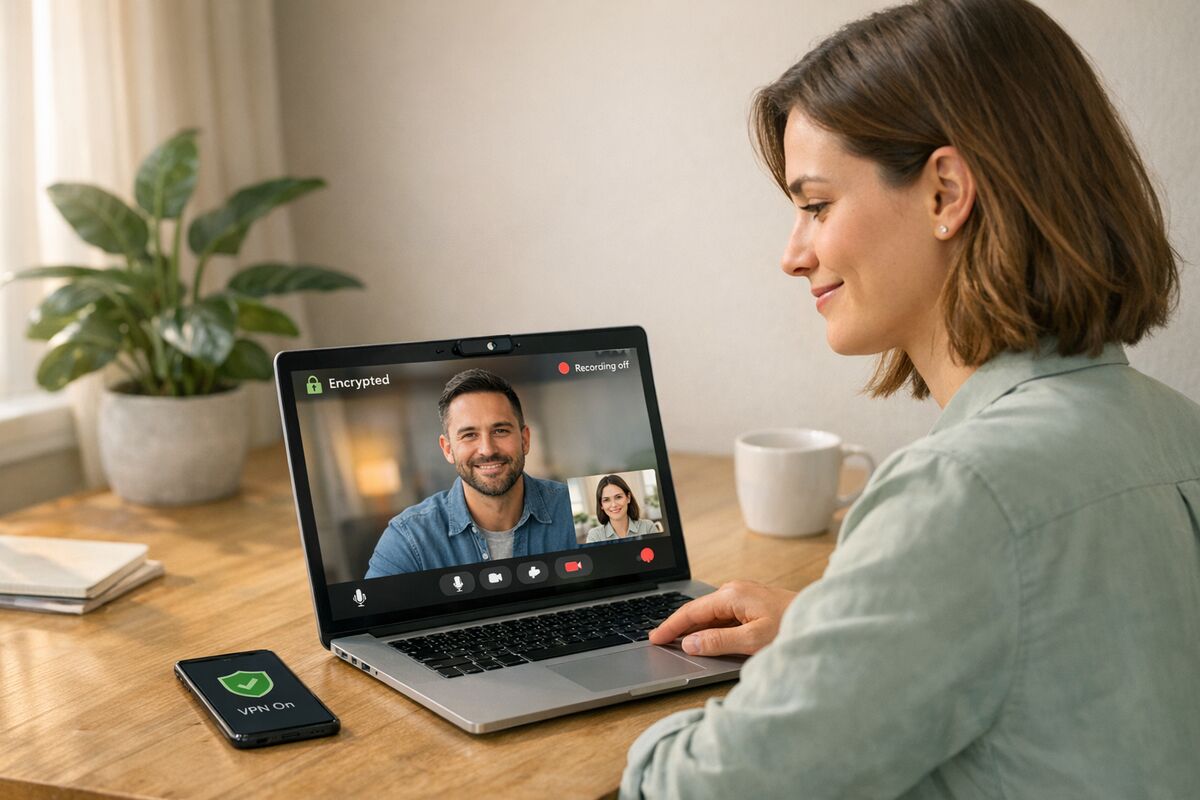
Do You Need a VPN for Random Video Chat?
A VPN genuinely hides your IP from chat partners, and genuinely causes most mystery bans. The honest cost-benefit, from a site that sees both sides.
The VPN question splits random chat users into two camps: those who would never chat without one, and those who tried one once, got banned somewhere, and swore off the idea. Both camps are responding to something real. We run Glimr, a video chat site, which gives us a view of both sides of this trade, so here is the honest accounting.
What a VPN actually protects in video chat
One thing, mainly, and it is not nothing: your IP address, as seen by the person you are matched with.
Most video chat sites, ours included, carry video peer-to-peer where possible, because sending video directly between two browsers is faster and cheaper than relaying it through servers. A side effect of how that technology negotiates a connection is that the two peers can learn each other's IP addresses. A technically inclined stranger can read yours from the connection, and an IP address maps loosely to a city and an internet provider. Not your street address, despite what dramatic YouTube videos imply, but more geography than some people care to share with a random stranger.
A VPN genuinely fixes this. The stranger sees the VPN server's address, and your city stays yours. If you chat a lot and value that layer, the case for a VPN is real. The same goes for untrusted networks, hotel and airport Wi-Fi, where a VPN is simply good hygiene regardless of what you are doing on it.
What a VPN costs you
Three things, and the first is the big one.
Bans you did not earn. Anonymous chat sites enforce bans against IP addresses, and a VPN exit node is one address shared by thousands of strangers. If any of them got banned on a site, everyone arriving through that address can inherit the flag. This is the leading cause of the ban-on-first-visit mystery we covered in our guide to unexplained bans. The privacy tool and the ban system are fighting over the same identifier, and the ban system does not know you exist.
Video quality. Your video now detours through a relay that might be a continent away, and on a real-time call every added millisecond shows. Choppy video and audio drift are the tax, sized by distance to your VPN server.
Some doors close. A number of chat platforms block known VPN ranges outright, judging that the abuse arriving through them outweighs the privacy-minded users. You will discover which ones empirically.
What a VPN does not do
It will not defeat a ban for long, and we would tell you that even if we did not run a site that bans people. Platforms flag more than addresses, browser fingerprints among them, and rule-breaking behavior regenerates its own bans wherever it goes. It also does nothing about the thing that actually identifies you in video chat: your face, on camera, plus whatever you say. The most common privacy failure in this category has always been a person cheerfully telling a stranger their full name and workplace while their VPN hides the city they already mentioned.
So, do you need one?
For chatting from home on a trusted network: genuinely optional. The realistic risk a VPN addresses is a stranger reading your rough location from the connection, and you can judge how much that matters to you. For frequent chatting, public Wi-Fi, or anyone whose threat model includes a nosy ISP: reasonable, paid for in latency and occasional inherited bans. For getting unbanned: save your money.
More on what actually protects you on camera, which is mostly behavior, in our privacy guide for video chats. And whichever camp you land in, Glimr works the same either way: camera on, one click, stranger.